
Hot
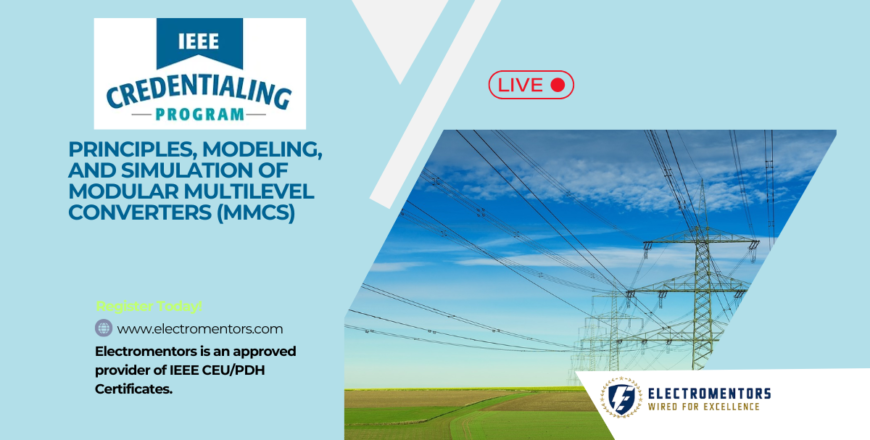
Principles, Modeling, and Simulation of Modular Multilevel Converters (MMCs)

Instructor
Prof. Shaahin Filizadeh
1
Student
enrolled
- Description
- Curriculum
- Reviews
Service Description
Date: Saturday, July 11, 2026
8:00 AM
4 hours
Eastern Standard Time (EST)
Price: 400 USD
Title: Principles, Modeling, and Simulation of Modular Multilevel Converters (MMCs)
This comprehensive and technically focused course provides a structured introduction to Modular Multilevel Converters (MMCs), one of the most important converter topologies in modern HVDC systems, STATCOMs, and high-power renewable integration applications.
MMCs are widely adopted due to their scalability, superior harmonic performance, and suitability for high-voltage applications. However, their multi-layer control architecture and complex internal dynamics require careful modeling and simulation, especially for EMT studies and detailed system-level analysis.
This course bridges theory and simulation practice, guiding participants through MMC topology fundamentals, control hierarchy, modeling approaches, and hands-on simulation examples in PSCAD/EMTDC.
Participants will explore:
• MMC submodule structures and arm configurations
• Half-bridge and full-bridge MMC topologies
• Internal circulating currents and capacitor voltage balancing
• Hierarchical control layers (inner, outer, and supervisory control)
• Detailed switching models vs. average-value models
• Trade-offs between model fidelity and computational efficiency
• EMT simulation techniques in PSCAD/EMTDC
• Practical implementation considerations for HVDC and grid-forming applications
Key Topics:
• Overview of MMC architecture and operating principles
• Submodule modeling and arm dynamics
• Control layers: current control, voltage control, energy balancing
• Circulating current suppression methods
• Detailed equivalent models in EMT platforms
• Average-value modeling techniques for faster simulations
• Practical PSCAD/EMTDC implementation examples
Who Should Attend?
• Power system engineers working with HVDC and FACTS
• EMT simulation engineers
• Converter and control engineers
• Utility and consulting professionals
• Researchers and graduate students in power electronics and power systems
Learning Outcomes:
By the end of the course, participants will be able to:
• Explain the operating principles of MMC topology
• Understand and describe MMC control hierarchy
• Differentiate between detailed and average-value models
• Implement MMC models in PSCAD/EMTDC
• Select appropriate modeling approaches based on study objectives
Instructor: To be announced
Notes:
• All participants will receive digital course materials (slide decks and reference resources).
• Upon successful completion, you will earn the ElectroMentors Certificate of Completion.
• ElectroMentors is an approved provider of Engineering Institute of Canada CEU/PDH accreditations (optional add-on available during checkout).
• The course may be eligible for Professional Development Hours (PDHs) with engineering regulatory bodies across Canada.
• All purchases are final. Registration confirms agreement with ElectroMentors’ Terms and Conditions.
Upcoming Session
Saturday, July 11, 2026
8:00 AM
4 hours
Eastern Standard Time (EST)
Course Info and Microsoft Teams Link

Quiz

Course Post-Session Feedback
Please, login to leave a review